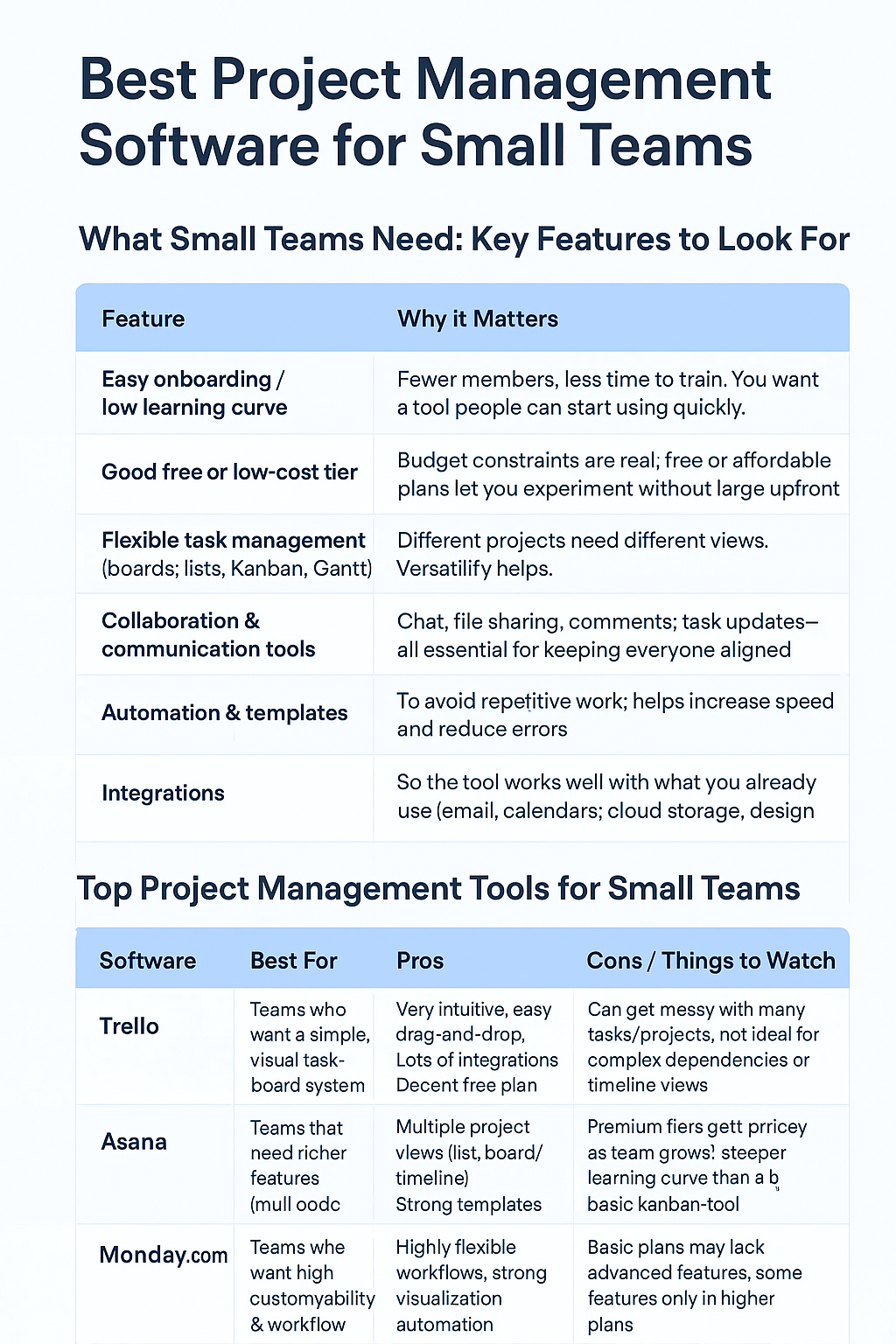
Best Project Management Software for Small Teams
Small teams need tools that are simple, affordable, and effective. The right project management software (PMS) can streamline workflows, improve collaboration, and help you deliver on time — but the wrong one can waste money and cause friction. Here’s a guide to choosing the best PMS for small teams, followed by top options as of 2025.
What Small Teams Need: Key Features to Look For
Before selecting software, consider the following criteria. These are vital for small teams:
| Feature | Why It Matters |
|---|---|
| Easy onboarding / low learning curve | Fewer members, less time to train. You want a tool people can start using quickly. |
| Good free or low-cost tier | Budget constraints are real; free or affordable plans let you experiment without large upfront cost. |
| Flexible task management (boards, lists, Kanban, Gantt) | Different projects need different views. Versatility helps. |
| Collaboration & communication tools | Chat, file sharing, comments, task updates—all essential for keeping everyone aligned. |
| Automation & templates | To avoid repetitive work; helps increase speed and reduce errors. |
| Integrations | So the tool works well with what you already use (email, calendars, cloud storage, design tools etc.). |
| Scalability | As your team grows, you should be able to add users, upgrade plans, and gain more functionality. |
| Reporting & visibility | Dashboards, progress tracking, dependencies, milestones help you see where you are at any time. |
Top Project Management Tools for Small Teams
Here are some tools that tend to do well for small teams, along with their strengths and trade-offs. I’ve gathered from recent comparisons and reviews. services.empyra.com+7Lark Suite+7UMA Technology+7
| Software | Best For | Pros | Cons / Things to Watch |
|---|---|---|---|
| Trello | Teams who want a simple, visual task-board system (Kanban) | Very intuitive, easy drag-and-drop, lots of integrations, decent free plan. clientramp.com+2Lark Suite+2 | Can get messy with many tasks/projects; not ideal for complex dependencies or timeline views. |
| Asana | Teams that need richer features (multiple views, task dependencies, reporting) | Multiple project views (list, board, timeline), strong template & integrations, good free/premium tiers. services.empyra.com+3UMA Technology+3Jotform+3 | Premium tiers can get pricey as team grows; steeper learning curve than a basic kanban-tool. |
| Monday.com | Teams who want high customizability & workflow automation | Highly flexible workflows, strong visualization, automation, useful templates. HostPapa United States+2Techopedia+2 | Basic plans may lack advanced features; sometimes extra cost for storage or advanced permissions. |
| ClickUp | One tool to do many things: docs, tasks, dashboards | Very feature-rich, many integrations, good value, flexible view options. clientramp.com+1 | Because it offers many features, it can be overwhelming; possible overkill for very simple workflows. |
| Wrike | Teams needing real-time reporting, moderate automation, and scalability | Strong reporting/analytics, useful automation, good structure. Techopedia+1 | Pricing climbs with advanced features; some features only in higher plans. |
| Zoho Projects | Budget-conscious teams, especially those already using Zoho suite | Good basic project planning, time tracking, collaboration features at lower cost. blog.teamaimed.com | May lack extreme depth of features in premium tools; UI can feel less polished. |
| Teamwork | Service or client-facing small teams who need time tracking & billing + PM | Balanced features: task management, timesheets, collaboration. blog.teamaimed.com | Extra features might need higher tier; not always the lightest tool. |
How to Choose the Right One
To pick the best for your team, follow these steps:
- Define your workflows & pain points
What problems do you want to solve? Missed deadlines? Poor visibility? Communication gaps? Knowing what hurts helps you pick features you really need. - Start with a free trial / free plan
Test with your real work, real people. Even a 5-user trial can expose friction. - Check for integrations
If you use Gmail, Slack, Google Drive, Dropbox, Figma, etc., make sure the PMS connects. Otherwise, you’ll end up shuffling between tools. - Ensure mobile & remote-friendly
At least some work is done off-office. A good mobile app and remote availability is important. - Plan for growth
Even if you’re 3-5 people now, think ahead to 10-20. You may need more projects, users, storage, advanced permissions. Make sure scaling won’t cost disproportionately. - Get team buy-in
If only one or two people use the tool well, but the rest resist, it won’t work. Make sure everyone is comfortable, give training, simplify where needed.
What’s Best Depends on Team Style
Different teams have different styles. Here are a few scenarios:
- Creative / Marketing team: Prefer flexibility, boards, visual content, integrations with cloud storage and design tools. (e.g. Trello, Asana, Monday.com)
- Technical / Software dev: Need dependency management, versioning, bug tracking, sprints, maybe integrations with code tools. (e.g. Jira + maybe Wrike or ClickUp)
- Client-facing or Consultancy: Need time tracking, billing, invoices + task management (Teamwork, Zoho, ClickUp)
- Operations / Admin workflows: Standard tasks, approval processes, maybe recurring tasks. (Asana, Monday, or simpler tools might suffice)
Sample Comparison: Free / Entry-Level Cost
Here’s a rough cost / entry-tier comparison (as of mid-2025 data, may vary):
| Tool | Free Plan Available? | Entry Paid Tier (per user / month) |
|---|---|---|
| Trello | Yes clientramp.com+1 | Approx US$5-10 J.Caresse & Company+2clientramp.com+2 |
| Asana | Yes (basic features) UMA Technology+1 | ≈ US$10-12 J.Caresse & Company+1 |
| Monday.com | Limited free trial / tier Techopedia+1 | ≈ US$9-12 depending on features Techopedia+1 |
SEO Tips If You’re Writing About/Promoting PMS
- Use keywords like “project management software for small teams”, “best project management tools 2025”, “affordable project management software” etc. naturally in headings, first paragraph, and meta description.
- Include comparison tables — Google likes tables for “compare” type content.
- Use clear headings (H2, H3) so people (and Google) can scan.
- Link out to official product pages for credibility.
- Keep content up-to-date; pricing/features change often.
Conclusion
There is no “one size fits all” solution — the best project management software for one small team might be too bloated or too basic for another.
If I had to pick one all-rounder: Asana or ClickUp are strong bets. They give enough functionality for growing teams without being overwhelming at the start. If your team wants simplicity and visual task tracking, Trello is a great beginning.